What is sorting?
Sorting is a process that organizes a
collection of numerical or alphabetical data into ascending or descending
order. Sorting process arranges the data into meaningful order so that you can
analyse it more effectively. Efficient sorting is important for optimizing the
efficiency of other algorithms that require input data to be in sorted lists.
Why sorting is required?
In our day-to-day life we keep our
necessary things at particular place, in a particular way to get it easily
whenever needed. We sort them in various aspects as per the requirement for
their easy handling. This sorting mechanism saves our time in finding that
thing too.
In the similar manner, if we think
about the huge data structures made in order to save large amount of data,
there we require such sorting algorithm. In several applications where huge
amount of data is stored, there is a need of sorting that data in a particular
order to access it efficiently.
To overcome above mentioned needs,
sorting of data in particular order is required. This sorting can be done by
different techniques and algorithms using a computer program.
Stable and Not Stable Sorting
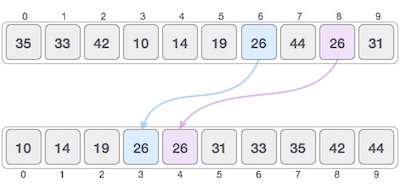
If a sorting algorithm, after sorting the contents, does not change the sequence of similar content in which they appear, it is called stable sorting.
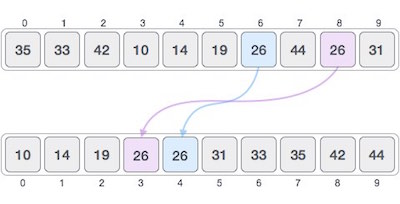
If a sorting algorithm, after sorting the contents, changes the sequence of similar content in which they appear, it is called unstable sorting.
Sorting techniques:
We have many sorting techniques to
carry out the sorting in efficient manner. These sorting techniques mainly
differ in their algorithm or pattern of sorting data.
1.
Quick Sort:

Quick sort is a highly efficient
sorting algorithm which is based on partitioning of array of data into smaller
arrays. In quick sort, a large array is partitioned into two arrays one of
which holds values smaller than the specified value, say pivot, based on which
the partition is made and another array holds values greater than the pivot
value. Quicksort partitions an array and then calls itself recursively twice to
sort the two resulting subarrays. This algorithm is quite efficient for
large-sized data sets.
|
Complexity |
Best Case |
Average Case |
Worst Case |
|
Time Complexity |
O(n) for 3 way
partition or O(n log n) simple partition |
O(n log n) |
O(n2) |
|
Space Complexity |
O(log n) |
2.
Bubble Sort:

|
Scenario |
Complexity |
|
Space |
O(1) |
|
Worst case running time |
O(n2) |
|
Average case running time |
O(n) |
|
Best case running time |
O(n2) |
3.
Merge Sort:

|
Complexity |
Best case |
Average Case |
Worst Case |
|
Time Complexity |
O(n log n) |
O(n log n) |
O(n log n) |
|
Space Complexity |
O(n) |
4.
Insertion Sort:

Hence, named as “insertion sort”. It
repeats this insertion procedure until no element is left. It takes one array
element (except 1st element of array) and compare it with one prior (previous)
element. If prior element is smaller, then u can say that array element is on
proper place. If prior element is greater, move it one step forward in array
and compare array element with another prior element. Continue this process
until you get smaller element. When you get smaller element, stop shifting and
insert array element on that correct position. This entire procedure is called
“one pass” which places one element at its exact location. Continue this
procedure for all elements and at last you will get sorted array.
|
Complexity |
Best Case |
Average Case |
Worst Case |
|
Time |
Ω(n) |
θ(n2) |
o(n2) |
|
Space |
o(1) |
5.
Selection Sort:

Selection sort finds the smallest element of the array and exchange it with the element on the first position. Then Find the second smallest element and exchange it with the element on the second position. Continue this process until the entire array is sorted.
|
Complexity |
Best Case |
Average Case |
Worst Case |
|
Time |
Ω(n) |
θ(n2) |
o(n2) |
|
Space |
o(1) |
6.
Heap Sort:

Heap sort is a comparison based sorting technique based on Binary Heap data structure. It is similar to selection sort where we first find the maximum element and place the maximum element at the end. The heap can be represented by a binary tree or array.
|
Complexity |
Best Case |
Average Case |
Worst case |
|
Time Complexity |
Ω(n log (n)) |
θ(n log (n)) |
O(n log (n)) |
|
Space Complexity |
O(1) |
7.
Radix Sort:

Radix sort is an integer sorting algorithm that sorts data with integer keys by grouping the keys by individual digits that share the same significant position and value (place value). Radix sort uses counting sort as a subroutine to sort an array of numbers.
|
Complexity |
Best Case |
Average Case |
Worst Case |
|
Time Complexity |
Ω(n+k) |
θ(nk) |
O(nk) |
|
Space Complexity |
O(n+k) |
8.
Bucket Sort:

Bucket sort, or bin sort, is a sorting algorithm that works by distributing the elements of an array into a number of buckets. Each bucket is then sorted individually, either using a different sorting algorithm, or by recursively applying the bucket sorting algorithm.
|
Algorithm |
Complexity |
|
Space |
O(1) |
|
Worst Case |
O(n2) |
|
Best Case |
Ω(n+k) |
|
Average Case |
θ(n+k) |

